
6 November 2026
NewsPricing, explained: hours back, not hours worked
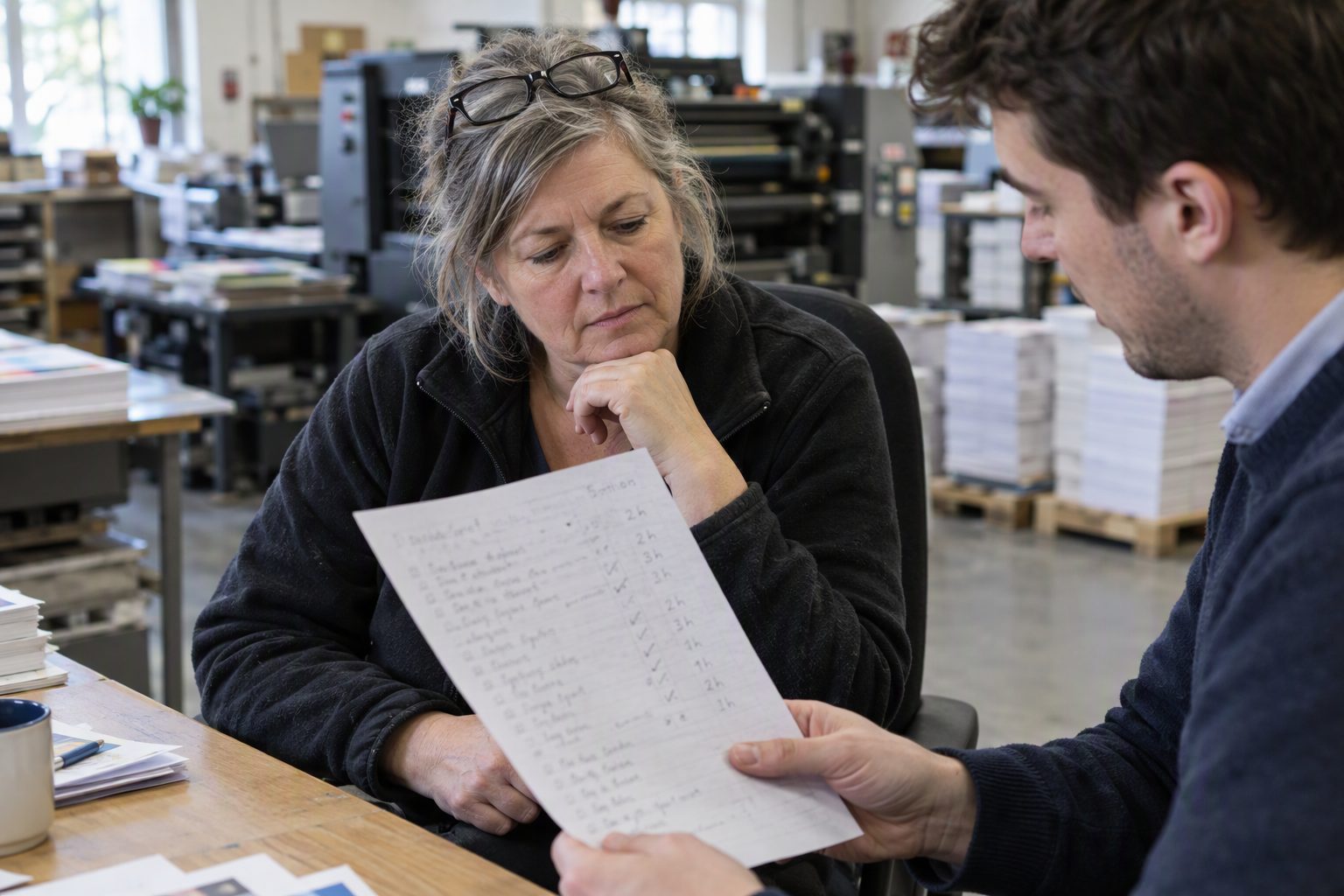
Most first projects land between €700 and €3,000, priced against the hours a process costs you and the mistakes it stops. Try the calculator in the post; here is how the number is built.
Ask us for a quote and the first thing we’ll ask about is your process, in hours. This post shows how the quote comes out of those hours, with a calculator partway down so you can run the arithmetic on your own workflow first.
The baseline comes first, always
Before any price exists, we work out what the current process costs you: who touches it, how many hours a week it takes, and what errors and redoing work add on top. You get this as a one-page baseline, in writing, before we quote anything.
Sometimes that baseline kills the project. If a task costs four hours a month, the right answer can be to keep the spreadsheet. We’d rather tell you that than quote something that never pays for itself. Every number in the quote is checked against the baseline you already agreed on.
The arithmetic itself
Once the baseline says it’s worth doing, the quote is built from two inputs you already know:
- The hours the process takes each week, including time lost to errors and redoing work, priced at what an hour of that work is worth to you. You set the rate yourself: a team member’s hour and an owner’s evening hour are worth different money.
- The scope: the smallest system that removes the most expensive part of the manual work, connected to the tools you already use.
Cross-reference the two and the price lands in a band you can sanity-check yourself. Most first projects come out between €700 and €3,000, because the scope is one boring loop. One more thing worth knowing: the price follows the loop, so it barely moves when more people are stuck doing the same thing; the saving is what multiplies.
Try it on your own workflow
The arithmetic, with sliders: the hours the process takes each week, what an hour of them is worth to you, how many people are stuck doing it, and the time errors add on top. Change any of them and the numbers follow:
3 h
1
≈ €45 / h
0.5 h
The math, checkable
each week
1 × 3.5 h × €45 = €158
over a month
≈ €680
over a year
≈ €8,200
Where a first project lands
€1,400 – €2,500
One process loop, automated end to end. At the top of that band, it pays for itself in about 4 months of the hours above.
The gap, side by side
Fills in the form at the bottom of this page; add your name and email and it’s on its way.
This is the shape of our arithmetic, not a quote; the baseline and proof of concept are where the real number comes from.
The calculator doesn’t model scope creep, discovery rabbit holes, or what the system saves after year one. The free proof of concept does that job.
Why not bill hours worked?
If we billed hours worked, a slower build would earn us more and a fast one would punish us. Paid against the hours a process hands back, our incentive and yours point the same way: get the loop running without humans, in the smallest shape that holds, so neither of us pays for gold-plating.
It also keeps the negotiation honest. A quote reads like “€1,800 against 3 hours a week at €35 an hour, paid back in about four months”. There’s a number in the sentence you can check against your own payroll: 3 × €35 × 4.33 weeks is about €455 a month, and €1,800 of quote at €455 a month is four months. Try doing that with a day rate.
Why the quotes look low
The market numbers make the difference stark. Edvido’s October 2026 analysis of 1,060 software development companies found the median published minimum project size is $10,000, and 60% of the firms that publish a minimum start at $10,000 or more. Guides on automation agency pricing put most first-time clients at $5,000 to $15,000. This band sits at €700 to €3,000.
The difference comes from how the work is scoped and sold. The builds are small on purpose: the core of one process, connected to the tools you already use. Conversations happen in writing, discovery is the one-page baseline, and the free proof of concept filters out projects that were never going to work before anyone quotes them. You own the code outright, so there’s no licence fee rolling forward. The timesheet dashboard and the confirmation platform on this blog are the loops this band exists to cover.
Payback looks reasonable next to those numbers, too. Automation pricing guides put typical payback for a first project at three to eight months; this band is priced at two to five months of the hours it removes. After that, the system keeps saving.
After the build
A new system needs looking at; it hasn’t met a month-end, a holiday rush, or the customer with the weird invoice yet. The way we keep that manageable is to build small in the first place: the core of the process first, scope creep pushed back on, few moving pieces. By launch, the due diligence on whether it actually works is done, and what’s left is spot checking. Spot checks we don’t charge for.
If a system grows into something that needs real ongoing care, we say so and quote a small monthly care plan. It stays optional, and the code stays yours outright.
The free proof of concept
Before any of this commits you to anything, we build a small, working demo of your real system, so you can click your actual workflow before deciding. Judge it with your team, then continue or walk away, and the demo is yours either way. It’s how both of us find out whether the baseline was telling the truth.
Frequently asked questions
What should I have ready before asking for a quote?
Nothing written. The baseline conversation is where the scope takes shape, so bring the process and the people who run it; the hours get counted together. If you already have a spec or a list of must-haves, bring that too, but it isn’t a prerequisite.
Can I just build it with AI instead?
For the screens, increasingly yes, and those parts have never been cheaper. The work that eats the weeks lives behind them: the database, accounts and permissions, email deliverability, backups, and whoever answers when something breaks at month three. Whether you build it yourself or pay someone, that’s the part to price. If it does get built, we’d rather it sit on a codebase you own and understand.
What happens if the work grows past the quote?
The quote is a number against the baseline you agreed to. Mid-build changes get quoted before they happen, and you decide whether to take them. When the baseline itself points at more than one build, we stage it: land the first useful piece inside a small project, then price later phases against the hours they hand back.
We tried automation before and it didn’t stick. Why would this be different?
Most attempts start by picking a tool and bending the process to fit. Starting from the hours works the other way round: if the baseline shows the process costs little, the advice is to keep the spreadsheet, and if it shows a real cost, the tool is chosen to fit the process.
Have a workflow that looks like this one? Tell us about it — a few sentences is enough.